It’s a well known fact that, like any contemporaries in a wide artistic field, authors like to hang out together. It makes sense — who else could a writer gripe to, swap critiques with, and steal ideas from? But sometimes we’re a little surprised as to the pairs that pop up in literary history — whether because of huge age differences, disparate personalities, or just issues of accessibility. Click through to see a few pairs of famous unlikely literary friendships that blossomed nonetheless, and if we’ve missed your favorite odd couple, let us know about it in the comments.
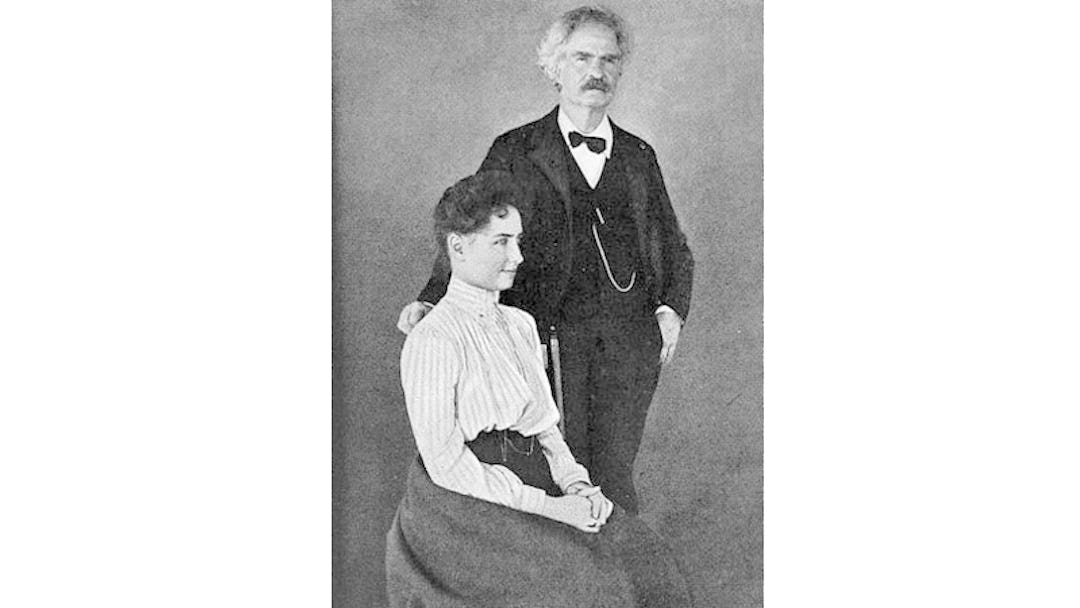
Mark Twain and Helen Keller
We would never have guessed that storied American humorist Mark Twain and deafblind author and activist Helen Keller — what with their 45-year age difference, among other things — were besties, but it seems they were. In an incredibly sweet and supportive letter Twain wrote to Keller in 1903, after reading her autobiography, he described their relationship as “an affectionate friendship which has subsisted between us for nine years without a break, and without a single act of violence that I can call to mind. I suppose there is nothing like it in heaven; and not likely to be, until we get there and show off. I often think of it with longing, and how they’ll say, “There they come—sit down in front!” I am practicing with a tin halo. You do the same.”
Henry James and Edith Wharton
Though Henry James and Edith Wharton shared, to a certain extent, subject matter, there wasn’t much else to draw them together. In fact, they twice attended the same dinner parties without noticing each other at all. However, around 1900, the pair struck up a polite correspondence that soon blossomed into a thriving epistolary friendship, Wharton writing to her “Cherest Maitre” and James responding to “Princesse Rapprochee!,” among other things. Though each writer was often threatened by the other, they helped each other through many a hard time — affairs, book deals, snubs. After all, what else are friends for?
J.D. Salinger and Ernest Hemingway
We’re not sure why we’re so surprised by this — maybe it’s just because we’ve had Salinger’s author-as-recluse image pounded into us so many times that we can’t imagine him hanging out with anyone, especially anyone as outdoorsy and brash as Hemingway. Or maybe it’s because Holden Caulfield totally hated that “phony book” A Farewell to Arms. But in fact, Salinger was very impressed by Hemingway when they first met in Paris during WWII — and vice versa. According to Vanity Fair , “He told one friend that Hemingway was essentially kind by nature but had been posturing for so many years that it now came naturally to him. Salinger disagreed with the underlying philosophy of Hemingway’s work. He said that he hated Hemingway’s ‘overestimation of sheer physical courage, commonly called ‘guts,’ as a virtue. Probably because I’m short on it myself.'” But despite their differences, the pair’s relationship — and their esteem for one another’s writing — only grew after this meeting.
Emily Dickinson and Thomas Wentworth Higginson
Well, considering what we know about how little Emily Dickinson left her house, its a wonder she was friends with anybody, much less a radical abolitionist writer during the Civil War. Though their personalities couldn’t have been more different, and though they only met face-to-face twice, the pair kept up an incredible correspondence for some 25 years, with Higginson acting both as friend and literary advisor — though even he didn’t know quite how great she was: after her death, he co-edited her poetry, taking out much of her incredibly specific punctuation.
Nathaniel Hawthorne and Herman Melville
When Nathaniel Hawthorne and Herman Melville met for the first time, the shy, careful Hawthorne was 46, and the wild seaman Melville fourteen years his junior — but neither difference in age nor temperament stopped the two men from hitting it off right away. Indeed, Melville was incredibly inspired by his relationship with Hawthorne, and eventually dedicated Moby-Dick to his friend. In an 1850 essay on Hawthorne’s Mosses from an Old Manse, Melville wrote, “To what infinite height of loving wonder and admiration I may yet be borne, when by repeatedly banquetting on these Mosses, I shall have thoroughly incorporated their whole stuff into my being,–that, I can not tell. But already I feel that this Hawthorne has dropped germinous seeds into my soul. He expands and deepens down, the more I contemplate him; and further, and further, shoots his strong New-England roots into the hot soil of my Southern soul.” Um, wow.
Harper Lee and Truman Capote
Harper Lee and Truman Capote might have the most famous author-on-author friendship of all time. While we can’t speak to how their personalities might have meshed as kids (they grew up together in Monroeville, Alabama), we’ve always found it a little funny that Lee turned out to be a recluse, uninterested in the limelight or the social aspect of the literary world, whereas Capote — well, you know. He loved celebrity so much that even when he had it in spades, he lied about having more. Plus there were all those legendary parties — we wonder if he ever convinced Lee to attend?